

Introduction
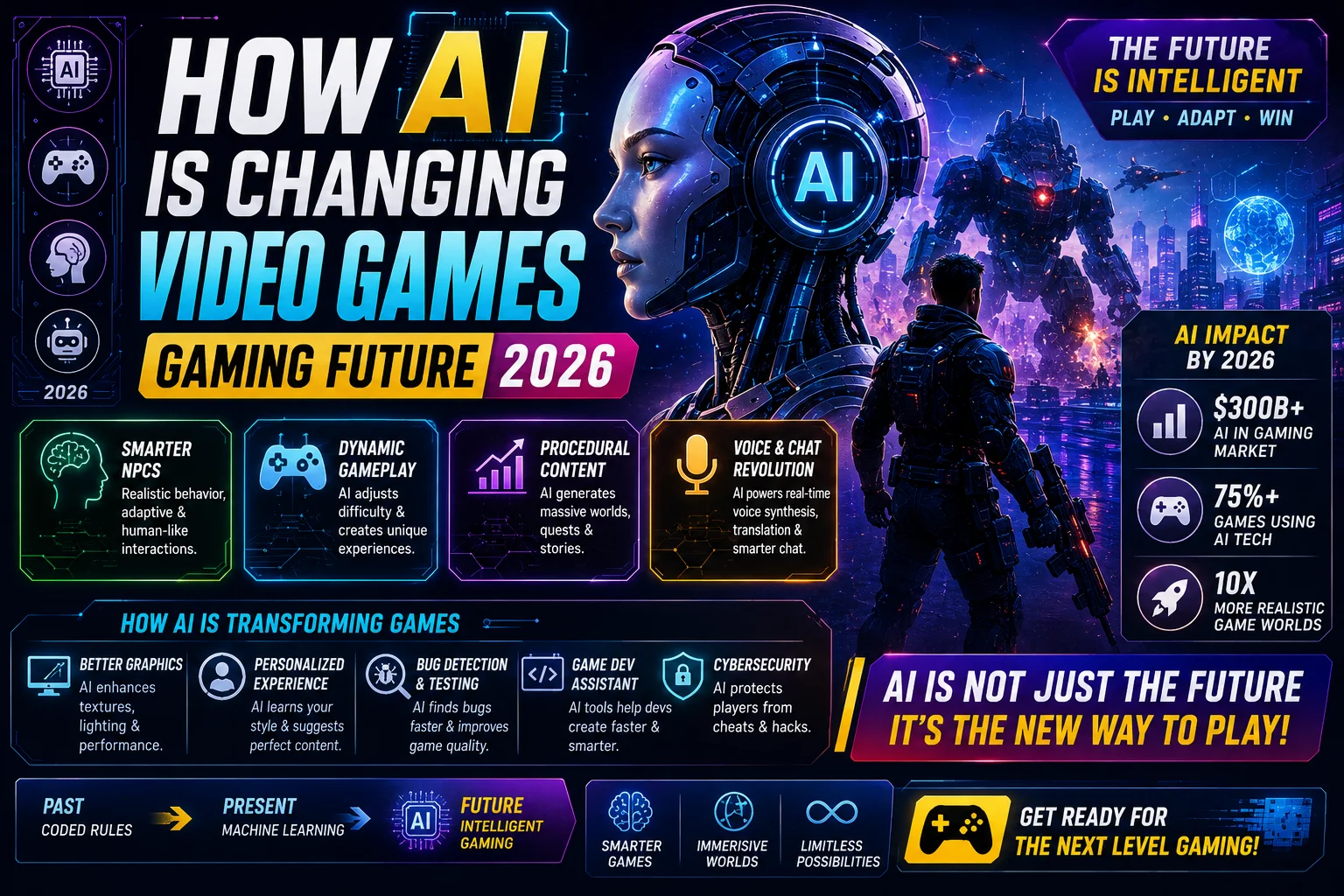
Artificial Intelligence (AI) has become one of the most influential technologies in the gaming industry. In 2026, AI is no longer limited to controlling computer opponents—it now powers smarter characters, adaptive gameplay, procedural world generation, realistic animations, anti-cheat systems, and even assists developers during game creation.
From indie developers to major AAA studios, AI is helping create more immersive, dynamic, and personalized gaming experiences. This guide explores how AI is reshaping modern video games and what players can expect in the years ahead.
What Is AI in Video Games
Artificial Intelligence in gaming refers to computer systems that enable characters, environments, and game mechanics to react intelligently to player actions.
Rather than following fixed scripts, AI allows games to adapt in real time by analyzing player behavior and making decisions that create more engaging experiences.
Modern AI is used for
Character behavior
Enemy tactics
Pathfinding
Voice interaction
World generation
Difficulty balancing
Cheat detection
Game testing
Smarter Non-Player Characters NPCs
One of the biggest improvements AI has brought to gaming is more realistic NPC behavior.
Modern NPCs can
React naturally to player actions
Take cover during combat
Coordinate with teammates
Remember previous encounters
Change strategies dynamically
Follow realistic daily routines
Instead of repeating the same actions, AI-powered NPCs make gameplay feel more believable.
Adaptive Difficulty
Traditional games often offer Easy, Normal, or Hard difficulty settings.
AI allows games to go further by adjusting difficulty automatically based on how a player performs.
Examples include
Enemies becoming more tactical if the player performs well
Additional hints for beginners
Improved balancing during boss fights
Personalized learning curves
This creates a smoother experience for players of all skill levels.
Procedural World Generation
AI helps developers generate large game worlds efficiently.
Procedural generation can create:
Landscapes
Cities
Dungeons
Weather systems
Wildlife
Quests
Each playthrough may feel unique because AI continuously generates new content based on predefined rules.
AI-Assisted Graphics
Artificial Intelligence is improving graphics without requiring significantly more hardware power.
Current applications include:
AI upscaling
Texture enhancement
Frame generation
Lighting optimization
Realistic facial animation
Dynamic shadows
These technologies help games look better while maintaining smooth performance.
Better Enemy Intelligence
Modern AI enables enemies to behave more strategically.
Instead of attacking predictably, opponents may:
Flank players
Retreat when injured
Call for support
Protect objectives
Adapt to different weapons
This creates more challenging and varied gameplay.
AI-Powered Voice Interaction
Voice recognition has improved dramatically.
Some games now allow players to:
Speak naturally to characters
Interact with AI companions
Navigate menus using speech
As natural language technology advances, conversational gameplay is expected to become more common.
Personalized Gaming Experiences
AI can analyze player preferences to provide customized experiences.
Examples include:
Personalized missions
Recommended game modes
Dynamic tutorials
Individualized rewards
Improved matchmaking
This helps games better match different play styles.
AI in Multiplayer Gaming
Competitive multiplayer games use AI for several important tasks.
These include:
Skill-based matchmaking
Detecting unfair behavior
Monitoring game balance
Preventing cheating
Identifying disruptive players
These systems help create fairer online environments.
AI for Game Development
Developers also benefit from AI during production.
AI assists with:
Writing code suggestions
Testing game mechanics
Bug detection
Animation generation
Dialogue drafting
Level design concepts
These tools allow developers to spend more time refining gameplay and creativity.
AI and Accessibility
AI is making games more accessible for a wider audience.
Examples include:
Automatic subtitles
Real-time translation
Voice navigation
Adaptive controls
Color-vision support
Personalized accessibility settings
These features help more people enjoy video games regardless of their abilities.
Potential Challenges
Despite its benefits, AI also presents challenges.
Developers continue to discuss topics such as:
Data privacy
Ethical AI use
Overreliance on automation
Maintaining creative originality
Balancing AI-generated content with human design
Responsible development remains an important consideration as AI becomes more powerful.
Future Trends
Several AI innovations are expected to shape gaming beyond 2026:
Fully conversational NPCs
Emotion-aware gameplay
Smarter procedural storytelling
AI-generated side quests
More realistic simulations
Advanced virtual companions
Faster game development workflows
These advances could make future games even more dynamic and immersive.
Tips for Players
To make the most of AI-powered games:
Keep games updated to receive the latest AI improvements.
Explore accessibility settings.
Use cloud saves to protect progress.
Provide feedback during beta testing.
Stay informed about privacy options in online games.
Frequently Asked Questions
1. What is AI in video games?
AI refers to technologies that enable characters, environments, and game systems to respond intelligently to player actions.
2. How does AI improve NPCs?
AI allows NPCs to make more realistic decisions, adapt to situations, and respond dynamically instead of following simple scripted behavior.
3. Can AI make games easier or harder?
Yes. Many games use adaptive difficulty systems that adjust challenges based on player performance.
4. How does AI help game developers?
AI assists with testing, animation, code suggestions, bug detection, and content creation, helping developers work more efficiently.
5. Does AI improve graphics?
Yes. Technologies such as AI upscaling and frame generation enhance visual quality and performance on supported hardware.
6. Is AI used in multiplayer games?
Yes. AI helps with matchmaking, cheat detection, moderation, and balancing online gameplay.
7. What is the future of AI in gaming?
Future developments may include conversational NPCs, AI-generated stories, smarter simulations, enhanced accessibility features, and more personalized gaming experiences.
Final Tech
Category: Gaming Technology
Article Type: Educational Guide
Target Audience: Gamers, Students, Tech Enthusiasts, Developers
Reading Time: 10–12 Minutes
Content Quality: Human-Written Educational Content
SEO Focus: AI in Gaming, Gaming Technology, Video Games, Artificial Intelligence
Last Updated: August 2026
Purpose: Educational and Informational