

Is Online Betting Legal in India State-Wise Guide 2026
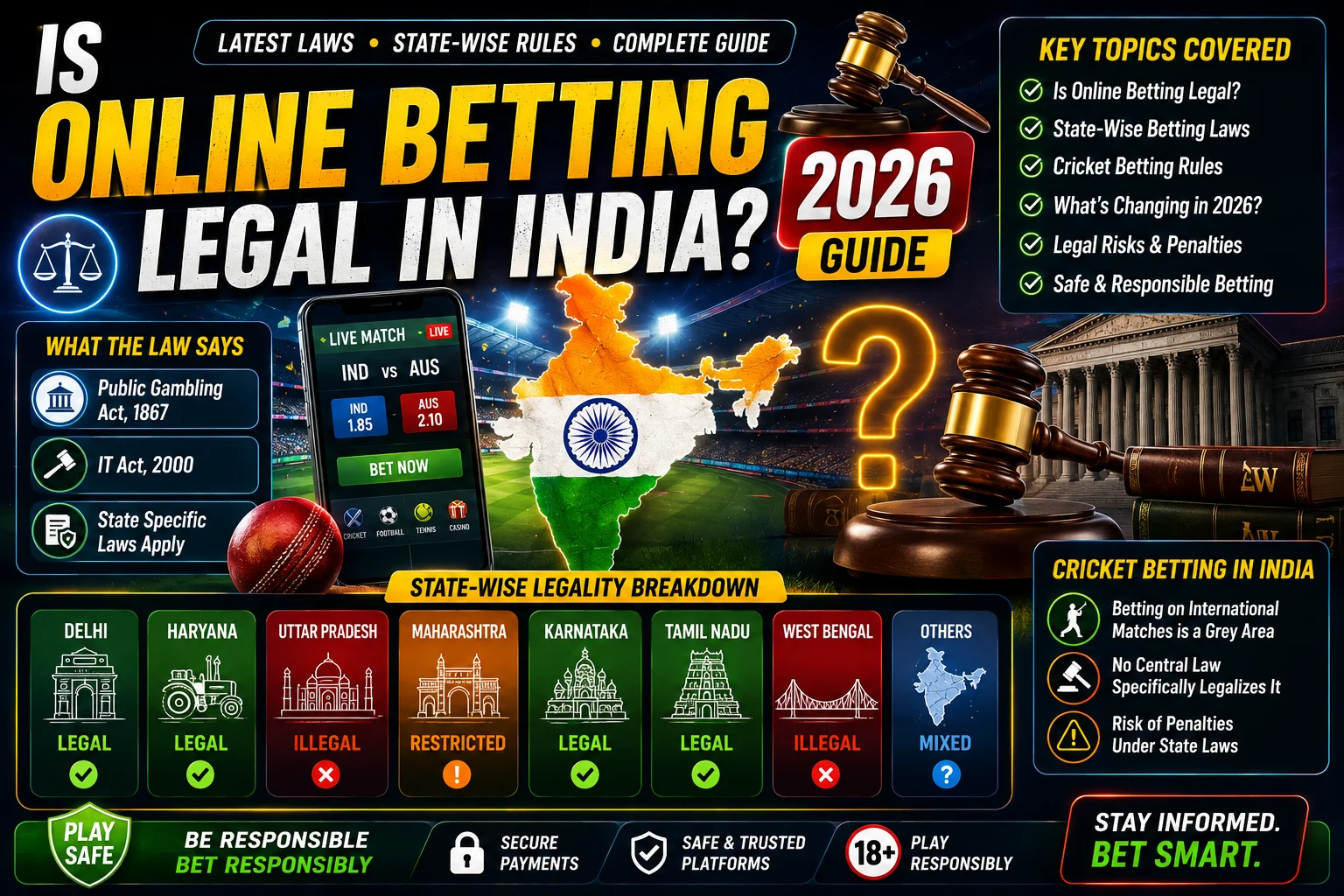
Online betting in India is not governed by a single national law. Legality depends on your state, the type of game (skill vs. chance), and the platform. Most states allow skill-based games, while states like Goa, Sikkim, and Meghalaya permit certain forms of licensed gambling. Sports betting remains largely unregulated federally as of 2026.
Online betting in India sits in one of the most complex legal grey zones of any country in the world. There’s no single national law that says “betting is legal” or “betting is illegal.” Instead, a patchwork of colonial-era statutes, state amendments, and recent Supreme Court rulings determines what you can and cannot do—depending entirely on where you live.
The Public Gambling Act of 1867 is the foundational federal law, but it’s nearly 160 years old and makes no mention of the internet. Individual states have since layered their own legislation on top of it, creating a landscape where something perfectly legal in Sikkim could land you in trouble in Maharashtra.
For anyone placing bets on cricket, kabaddi, or football in 2026, understanding these distinctions is not optional—it’s essential. This guide breaks down online betting laws state by state, explains the critical skill-versus-chance distinction, and clarifies exactly where India stands on cricket and sports betting this year.
What Laws Actually Govern Online Betting in India
Before diving into state-specific rules, it helps to understand the legal framework at the national level.
The Public Gambling Act, 1867 prohibits operating or visiting a “common gaming house.” However, because this law predates the internet entirely, courts have consistently struggled to apply it to online platforms. The law also carves out an explicit exception for “games of mere skill,” which has become the cornerstone of India’s online gaming industry.
The Information Technology Act, 2000 governs online activity broadly but does not directly address gambling or betting. No federal legislation has been passed since to fill that gap.
The Prize Competitions Act, 1955 restricts competitions involving prizes where outcomes depend on chance—but again, skill-based games are excluded.
In 2021, the Supreme Court of India reaffirmed that fantasy sports platforms like Dream11 constitute games of skill, not chance. This ruling has since been used by multiple operators to justify their presence in the Indian market. As of 2026, the central government has not enacted a unified online gambling law, leaving state governments as the primary regulators.
The Skill vs Chance Distinction Why It Matters So Much
The single most important concept in Indian betting law is this: games of skill are generally legal; games of pure chance are not.
A game of skill is one where the outcome is determined primarily by a player’s knowledge, strategy, or expertise—not random chance. Rummy, chess, and fantasy cricket have all been classified as skill-based games by various Indian courts.
Games of chance—like slot machines or certain lottery formats—rely primarily on random outcomes. These are subject to far stricter restrictions and are typically only permitted in states with formal gambling legislation.
This distinction directly affects sports betting. Betting on the outcome of a single cricket match is typically classified as a game of chance. However, fantasy sports platforms, where users build teams based on player analysis, have successfully argued they fall under the skill category.
State-Wise Online Betting Laws in India 2026
Is Online Betting Legal in Delhi
Delhi follows the Public Gambling Act of 1867 without major amendments. Online betting on sports outcomes is legally permitted in Delhi. However, fantasy sports platforms operating under the skill-game exemption continue to function openly, and no Delhi-specific law has been passed to ban them outright as of 2026.
Residents should note that while enforcement against individual users is rare, operating an unlicensed gambling platform in Delhi carries criminal liability.
What Are the Betting Laws in Haryana Faridabad and Sonipat
Haryana, including cities like Faridabad and Sonipat, applies the Punjab Public Gambling Act of 1867—a regional of the central law inherited from its pre-partition administration.
Faridabad betting laws: No licensed betting shops or casinos exist. Online sports betting is unregulated and technically illegal under state law. Fantasy sports apps operate in a grey zone.
Sonipat betting laws: Identical legal framework to Faridabad. No specific municipal ordinances change the situation.
Haryana has not proposed any gambling liberalization legislation as of early 2026, making it one of the more conservative states on this issue.
Is Online Betting Legal in Uttar Pradesh
Uttar Pradesh enforces a strict interpretation of gambling laws. The UP government has not passed any legislation legalizing online betting or casinos. Skill-based games exist in a grey area, similar to Delhi and Haryana.
The Uttar Pradesh government introduced drafts for a gaming regulation policy in 2023, but no final law had been enacted by 2026. Online fantasy sports platforms remain accessible but operate without formal state licensing.
States Where Online Betting Is Explicitly Legal or Regulated
A handful of Indian states stand out for having proactively regulated gambling:
Goa is the most well-known exception. Goa legalizes casinos under the Goa, Daman and Diu Public Gambling Act, 1976. Both land-based and offshore (ship) casinos operate legally here. Online betting from Goa remains a grey area since no specific online gambling licensing framework exists at the state level.
Sikkim passed the Sikkim Online Gaming (Regulation) Act in 2008, making it the first Indian state to attempt online gambling regulation. Licensed operators can legally offer certain games within the state. However, the scope is limited, and interstate licensing remains unresolved.
Meghalaya enacted the Meghalaya Regulation of Gaming Act in 2021, creating a formal licensing regime for both land-based and online games. Meghalaya is currently one of the most progressive states on online gambling regulation in 2026.
Nagaland passed the Nagaland Prohibition of Gambling and Promotion and Regulation of Online Games of Skill Act in 2016, explicitly licensing skill-based online games. This has made Nagaland an attractive licensing jurisdiction for fantasy sports operators.
States That Have Banned Online Gaming Outright
Several states have moved in the opposite direction, imposing outright bans on online games—even skill-based ones:
Tamil Nadu passed a gambling ban in 2021 that was partly struck down by the Madras High Court, but the state continues to restrict online gaming platforms aggressively.
Andhra Pradesh amended its gambling act in 2020 to ban online gaming, though enforcement remains inconsistent.
Telangana similarly banned online gaming through an amendment in 2017.
If you are located in these states, accessing online betting or gaming platforms carries greater legal risk than in other parts of the country.
Is Cricket Betting Legal in India
Cricket betting is the most searched gambling topic in India—and the answer is complicated.
Betting on cricket match outcomes is illegal in most Indian states. The BCCI (Board of Control for Cricket in India) and the Prevention of Money Laundering Act, 2002 both factor into enforcement, particularly around spot-fixing and match manipulation.
However, fantasy cricket platforms—where users draft teams and score points based on real player statistics—have been repeatedly upheld as legal skill games. Dream11, for instance, won a Supreme Court ruling in its favor in 2021. As of 2026, platforms like Dream11, MPL, and My11Circle operate openly across most Indian states.
For those looking to bet directly on match winners, run totals, or player outcomes, offshore betting platforms remain accessible but are technically illegal and unregulated. Users have no legal protection if disputes arise with such platforms.
Online Gambling Laws India 2026 Key Developments
The most significant regulatory development in 2026 is the continued rollout of the IT (Intermediary Guidelines and Digital Media Ethics Code) Amendment Rules, which classify online gaming platforms into two categories: permissible and non-permissible. A government-appointed Self-Regulatory Body (SRB) framework has been established to certify “permissible online real money games.”
This framework does not legalize sports betting outright, but it does create a clearer path for skill-based gaming operators to gain legitimacy. As of mid-2026, the SRB certification process is active, and several major platforms have applied for compliance status.
A federal online gaming bill has been discussed repeatedly in Parliament but has not yet passed. Experts from the Vidhi Centre for Legal Policy and observers at the All India Gaming Federation anticipate potential central legislation by 2027.
How to Stay Legally Safe When Betting Online in India
Given the complexity of the law, here are practical steps every Indian bettor should take:
Check your state’s specific laws before using any betting platform. What’s grey in Delhi may be explicitly banned in Telangana.
Prefer licensed Indian platforms over offshore sites. Licensed platforms under the new SRB framework offer consumer protections; offshore sites offer none.
Understand the game type. Skill-based games (fantasy sports, rummy) have far stronger legal protection than games of chance.
Avoid unlicensed operators. If a platform has no clear licensing information or is based in a jurisdiction you’ve never heard of, the risk is yours entirely.
Keep records of transactions for tax purposes. Winnings above ₹10,000 are subject to Tax Deducted at Source (TDS) at 30% under Section 194B of the Income Tax Act.
The Future of Betting Laws in India
India’s online betting legal landscape is evolving faster than its legislation. State-level experimentation—Meghalaya’s licensing model, Nagaland’s skill-game framework—is creating a blueprint that federal lawmakers are watching closely.
The economic argument for regulation is gaining traction. A 2023 report by KPMG estimated that India’s online gaming market could reach $5 billion by 2025, with fantasy sports accounting for a significant share. Tax revenues from a regulated sports betting market could be substantial—an argument that resonates with state finance ministers.
Whether India moves toward a unified federal betting law or continues down a state-by-state regulatory path, 2026 marks a pivotal year. Betters, operators, and legal professionals are all watching the same question: not if India regulates online betting more formally, but when.
Frequently Asked Questions
1. Is online betting legal in India in 2026?
Online betting is not uniformly legal or illegal across India. Legality depends on your state and the type of game. Skill-based games are broadly permitted in most states, while pure chance-based sports betting remains restricted or unregulated federally. States like Goa, Sikkim, and Meghalaya have formal licensing frameworks; most others do not.
2. Is cricket betting legal in India?
Direct betting on cricket match outcomes (e.g., who wins, total runs) is illegal in most Indian states. Fantasy cricket platforms—where outcomes depend on player selection skill—have been upheld as legal by the Supreme Court of India and operate openly as of 2026.
3. Are online betting apps legal in Delhi?
Delhi has no specific law legalizing online betting apps. Skill-based fantasy sports platforms operate in a legal grey zone and remain accessible. Direct sports betting apps are technically illegal under the Public Gambling Act of 1867, though enforcement against individual users is rare.
4. What are the betting laws in Haryana (Faridabad and Sonipat)?
Haryana follows the Punjab Public Gambling Act of 1867. No casinos or licensed betting shops exist in Faridabad or Sonipat. Online sports betting is not legally authorized, but fantasy sports platforms continue to operate under the national skill-game exemption.
5. Is online betting legal in Uttar Pradesh?
Online betting is not formally legalized in Uttar Pradesh. The state has no gambling licensing regime as of 2026. Fantasy sports are accessible but operate without state-level authorization. A regulatory draft was proposed in 2023 but not enacted.
6. What happens if I win money from an online betting site in India?
Winnings above ₹10,000 are subject to 30% TDS under Section 194B of the Income Tax Act. You must report these earnings in your income tax return. Failure to do so carries penalties under Indian tax law regardless of whether the betting platform itself is licensed.
7. Which states in India have legalized online gambling?
Sikkim, Meghalaya, Nagaland, and Goa have the most developed legal frameworks for gambling in India. Sikkim and Meghalaya offer online gaming licenses. Nagaland specifically licenses skill-based online games. Goa permits physical casinos and is exploring online frameworks. All other states either prohibit or leave gambling unregulated as of 2026